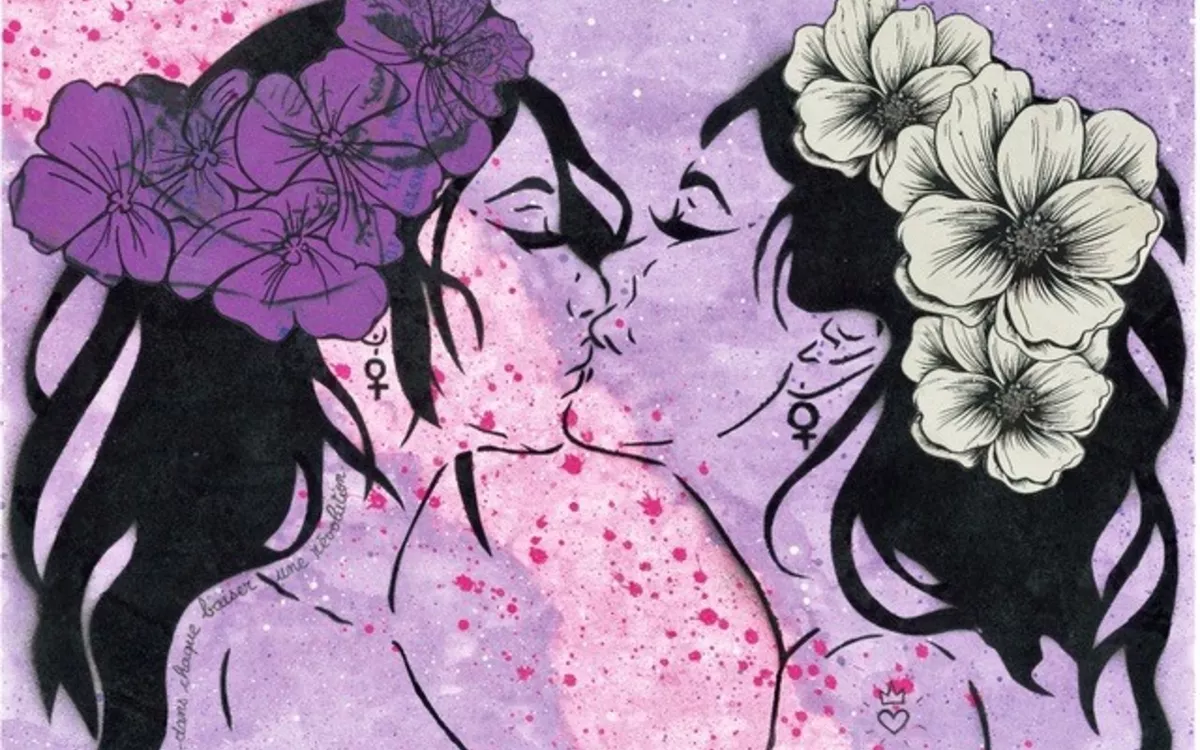
Exposition collective d'art urbain "Les violettes du Montparnasse ou comment les féministes et les les-biennes changent la société » organisée par Garidell 14
→ 08:00 PM
5 rue de Ridder - Paris
About the exhibition
Originally scheduled at the Montparnasse gallery as part of women's rights in March, then at the Festival des Dramagouines and the Salon du livre lesbien in May, this urban art exhibition will be held in November at the Aimé Césaire library for the LGBTQIA+ Pride Festival organized by the town hall of the 14th arrondissement of Paris.
Today, urban art is being embraced by feminist women artists who convey feminist messages on the walls of our streets, messages directly accessible to passersby of all ages and social backgrounds. A visual, especially a work of art, is often more eloquent and informative than a speech or text. It immediately strikes a chord and prompts reflection. This street art imprints powerful images in the mind. Women kiss, have hairy legs, and vulvas and clitorises are on display. The artists in this exhibition are giving voice to women's liberation, ultimately advocating for women's freedom to control their bodies, their sexuality, and public space—perhaps all the more effectively because their art is displayed in public spaces!
We are proud to be able to tour this exhibition to contribute to greater visibility and understanding of feminist and lesbian cultures, echoing the history of the Montparnasse district, the history of art, and the history of women's liberation. Indeed, even though feminists have won crucial battles for women's rights, these rights remain fragile, and there are still many battles to be won. Thus, while female homosexuality is no longer hidden today, it remains discreet and less vocal than that of other sexual minorities.
It is to ancient Greece that one must go back to find texts celebrating a proud and non-heteronormative sexuality, notably to the poet Sappho of the island of Lesbos, who celebrated lesbian love. And yet, freedoms were remarkable in the 1920s and the Belle Époque: the golden age of lesbian salons (the word "lesbian" appeared in 1925). But afterwards, frowned upon and rejected, lesbians hid and remained invisible until the 1980s.
This exhibition aims to make these issues visible through portraits of artists, writers, activists, and others who have reflected on their lesbianism. Indeed, lesbians have contributed to changing art and gender representations. They have also made significant contributions to several social movements (feminist, anti-AIDS, LGBTQ+, etc.). The years of the AIDS epidemic, which ravaged the homosexual community, triggered a radical activism towards the recognition of LGBTQ+ communities. The gay street artist Keith Haring, an activist for homosexual rights and the fight against AIDS, profoundly influenced how we view sexuality and gender, especially in the artistic and cultural spheres. The influence of LGBTQIA+ activists has altered the expectations of viewers as well as art exhibitors. Indeed, while Robert Mapplethorpe's work can still be shocking, it is far removed from the scandal of its initial appearance. Similarly, with the provocative works of Frida Kahlo. The Mexican artist always questioned femininity and masculinity, offering a feminist discourse and a fluid approach to bisexuality.
More specifically, in urban art, street art—the art form that reigns supreme in public spaces, where women are more prominently featured, an art form considered "outlaw" in its early days in 1960s and 70s New York—female artists remain a minority today. And they are endangered in certain countries where religious extremism dictates the moral and social order. Even though more and more women artists are painting immense walls, working in collectives, defending their art and visibility, and declaring themselves feminists, what about feminist and/or lesbian street artists? How do they express themselves? It seems they are forging a path through a hostile jungle, through questions about sexual identity and challenges to social gender roles, as posed by the first urban artists who deconstructed gender, like Kashink as early as 2013. But let's let the artists themselves answer that.
Important dates relating to the exhibition:
The exhibition will be held from November 5 to December 3, 2025.
Closing party with refreshments to celebrate the end of the exhibition; a final guided tour of the artworks will be offered. Wednesday, December 3rd, starting at 7 pm.
Adults, free entry.
Translated automatically - see original description in French